
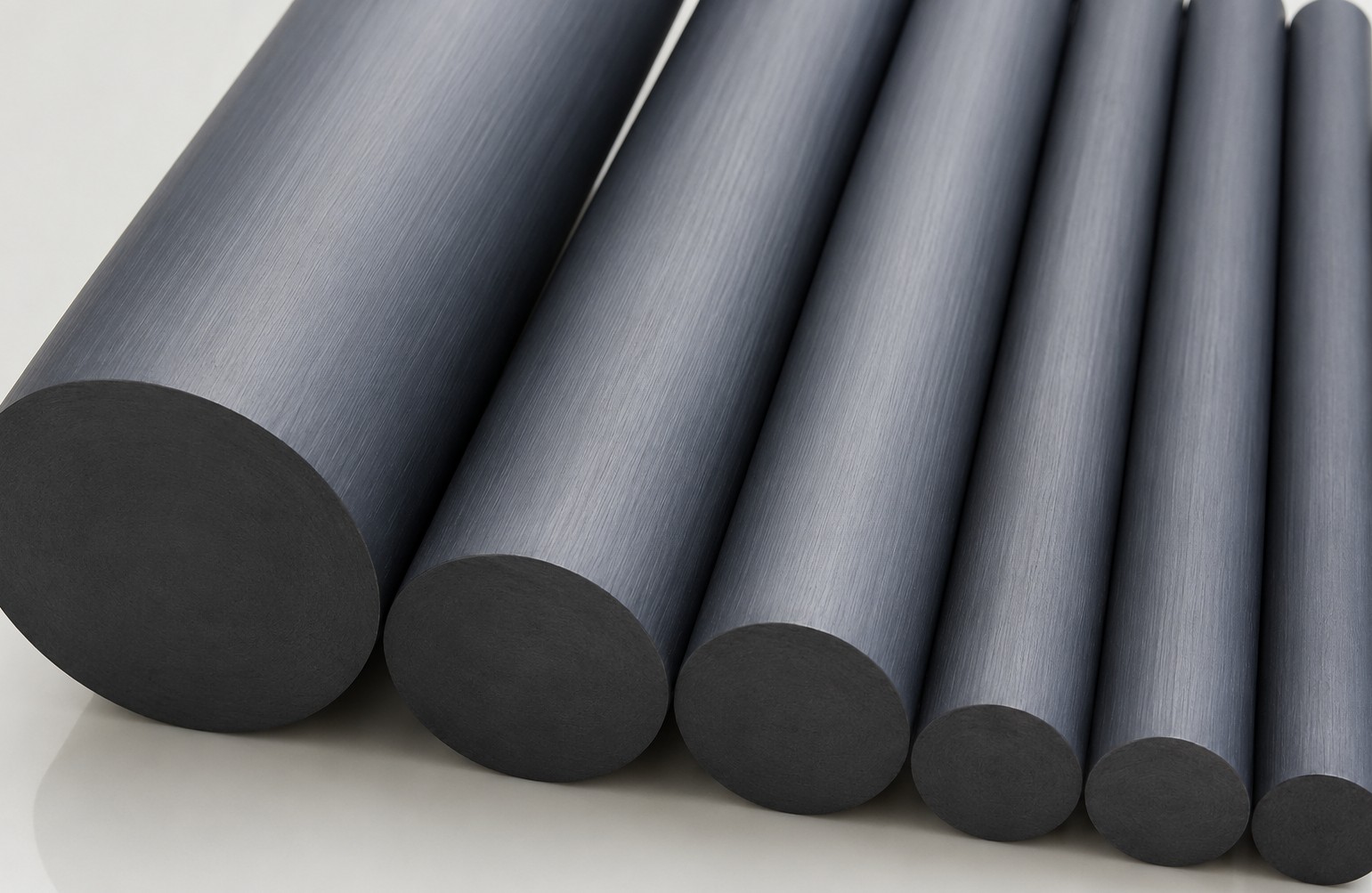
High-temperature heating elements for vacuum furnaces — service temperature up to 3000°C, with low thermal expansion, high thermal conductivity and excellent thermal-shock resistance at an economical price.
Graphite rods are commonly used as the electric heating element of high-temperature vacuum furnaces, with a maximum service temperature reaching up to 3000°C. At high temperature they oxidize easily, so apart from vacuum they can only be used in neutral or reducing atmospheres.
Graphite rods offer a relatively low coefficient of thermal expansion, relatively high thermal conductivity and a resistivity of (8–13)×10⁻⁶ Ω·m. They are high-temperature resistant, withstand extreme cold and heat well, and are economically priced.
Typical performance of our graphite heating rods.
| Property | Value |
|---|---|
| Maximum service temperature | up to 3000°C |
| Resistivity | (8–13)×10⁻⁶ Ω·m |
| Coefficient of thermal expansion | Low |
| Thermal conductivity | High |
| Thermal-shock resistance | Excellent |
| Working atmosphere | Vacuum / Neutral / Reducing |
Electric heating element / heating body for high-temperature vacuum furnaces.
Heating in neutral or reducing atmospheres where oxidation is prevented.
Sintering, brazing and heat-treatment processes up to 3000°C.
Very high maximum service temperature.
Small expansion coefficient for dimensional stability.
Fast, efficient heat transfer as a heating element.
Withstands rapid extreme heating and cooling.
Cost-effective heating element solution.
Consistent (8–13)×10⁻⁶ Ω·m electrical performance.
Handling note: graphite rods oxidize easily at high temperature. Apart from vacuum, use only in neutral or reducing atmospheres to protect the heating element and extend service life.
Send the diameter, length, furnace type and quantity — we reply with the right grade and pricing within one business day.